I wanted to share some of my reflections on a recent trip to Newfoundland for a week of hiking. It was one of the most beautiful places I have ever been. It reminded me in some ways, of our life journey; Sometimes smooth, sometimes surprising us with rocks and upturned roots.

With that in mind, I thought, strangely, an awful lot, about the walking sticks I brought on the trip.
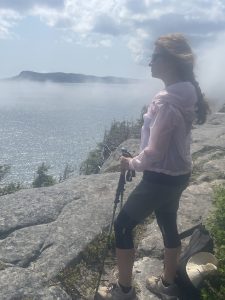
I feel the need to clarify that I could, technically, have survived the trip without them.
But why?
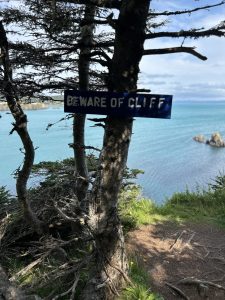
Because like life, I imagined I would encounter some steep climbs, rocks, roots, uneven trails and some wonderfully dramatic cliffs (without guardrails!). There were actually very few trails like the one in the photo below on the East Coast Trail that warned hikers to BEWARE OF CLIFF. We don’t always get those warnings unfortunately. But it’s probably advice worth following. Staying back from the edge…and using those walking sticks can definitely help reduce the risk of danger.
The walking sticks gave me a little lift regardless of what I encountered. They made some of the climbs easier. They gave me something to lean on when the ground underneath me wasn’t particularly cooperative. I’m not sure if every hike posed a particular danger (some did for sure!) – but some were just uncomfortable.
And as I walked, I found myself thinking about something I talk about with clients sometimes as we talk about relationships and how hard they can feel and be sometimes:
How do we know when we are actually in danger — and when we are simply uncomfortable?
Because anxiety can be remarkably bad at telling the difference.
Anxiety can make discomfort feel like danger
I’m not a fan of looking over cliffs. I can imagine the danger of falling. But there is a very real difference between standing too close to a cliff and having an uncomfortable conversation with someone you love.
One requires you to move away from the edge.
The other may require you to stay.
But our nervous systems don’t always make that distinction so neatly.
If you live with anxiety, uncertainty can feel dangerous. Conflict can feel dangerous. Disappointing someone can feel dangerous. Making the wrong decision can feel dangerous.
Even resting can sometimes feel strangely uncomfortable. Sound familiar?
You may notice an urge to:
- leave
- fix
- check
- explain
- reassure
- avoid
- make a decision immediately
And because the urge feels urgent, it can be easy to assume it must be important.
But an anxious nervous system can send a very convincing message:
“Something feels wrong, therefore something must be wrong.”
Those aren’t actually the same thing.
I noticed this in myself on the Newfoundland coast
One day, I watched fog rolling in from the ocean.
I had been warned about Newfoundland weather. The sun could be warm one minute and the landscape could suddenly feel cold and dark the next.
I knew this intellectually.
Still, when I watched that fog coming toward me, I noticed something in myself: Maybe I should get up and go…like now!
Nothing terrible had happened.
There wasn’t an immediate threat.
But my body didn’t particularly care about my intellectual understanding of weather patterns.
It registered change.
Uncertainty.
Reduced visibility.
And it reacted.
I found that fascinating — not because I think anxiety is something we should simply talk ourselves out of, but because it reminded me how quickly the body can move into protection (especially when close to a cliff!).
Sometimes an anxious “part” is trying to keep you safe
In therapy, I sometimes talk with clients about an anxious part of themselves.
Not because there is something wrong with them.
Quite the opposite.
Often, that anxious part developed because it was trying to help.
It may have learned that being prepared was safer than being surprised.
That anticipating other people’s reactions was safer than waiting to find out.
That leaving first was safer than being left.
That solving the problem quickly was safer than sitting with uncertainty.
These strategies can be incredibly useful.
Until they aren’t.
The problem isn’t necessarily that your anxious part exists.
It is that it may not always know whether you’re standing at the edge of a cliff or simply standing somewhere unfamiliar.
Anxiety and the fear of uncertainty
For many anxious people, the hardest part isn’t actually the situation.
It is not knowing.
What if something happens?
What if they are upset with me?
What if I make the wrong choice?
What if this feeling gets worse?
What if I can’t handle it?
The mind starts looking for certainty.
And because certainty is rarely available, the mind keeps working.
More analysing.
More checking.
More reassurance.
More imagining.
More trying to get ahead of whatever might happen next.
Sometimes anxiety becomes exhausting precisely because it is trying so hard to prevent discomfort.
Therapy isn’t about ignoring danger
This distinction matters.
I am not interested in telling someone with anxiety to simply “push through” everything.
There are genuine dangers in life. There are relationships that are unhealthy. There are situations where leaving is the right thing to do.
The work is developing greater discernment.
What is actually happening?
What am I feeling?
What is my body responding to?
What belongs to the present?
And what might be an old protective response showing up again?
That pause can create something anxiety often takes away:
choice.
Sometimes we need a walking stick, not a rescue
That became one of my favourite metaphors from the trip.
The walking sticks didn’t walk the trail for me.
They didn’t eliminate the steep hills.
They didn’t make the rocks disappear.
They simply gave me a little more support.
Therapy can sometimes work like that.
You don’t necessarily need someone to remove every uncomfortable thing from your life.
Sometimes you need support while you learn that you can experience discomfort without immediately interpreting it as danger.
You can have the difficult conversation.
You can sit with uncertainty.
You can feel anxious and wait before reacting.
You can notice the fog without assuming you have to run.
And you can learn, slowly, to ask a different question:
“Am I actually in danger — or am I uncomfortable because this matters?”
Sometimes that is where anxiety begins to loosen its grip.
Does anxiety make discomfort feel like danger? Learn how therapy can help.
I offer therapy for individuals, couples, families, blended families, and other relationships, and treat trauma, anxiety, grief, burnout, relationship challenges, and life transitions, from an attachment-based, trauma-informed, and relational perspective.
I offer both in-person therapy in Hamilton, Ontario, and online therapy across Ontario.
Book a Free Consultation
I invite you to reach out for a free 15-minute consultation. Together we can work to help you better cope with current stressors and explore what is happening beneath the surface.
Disclaimer: This blog is intended for educational purposes only and does not constitute psychotherapy, mental health treatment, or professional advice. Reading this article does not establish a therapist-client relationship. If you are experiencing a mental health crisis, please seek immediate professional support.
Verified client feedback and Professional Endorsements can be found on Luminos and Psychology Today
#AnxietyTherapy, #AnxietyAndUncertainty, #AnxietyAwareness, #MentalHealthOntario, #HamiltonTherapist, #NervousSystem, #EmotionalRegulation, #TraumaInformedTherapy